
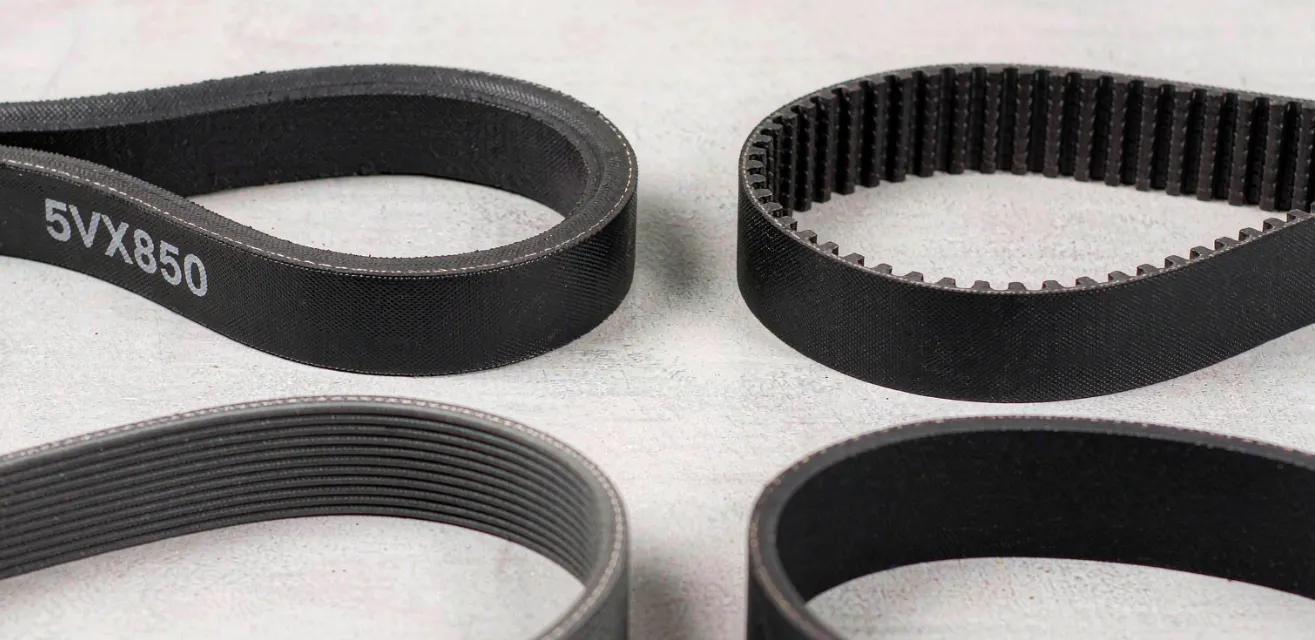
A belt looks simple. It's a loop of something flexible that moves power or product from one place to another. But ask anyone who's watched a line go down because a belt let go, and they'll tell you the "simple" part is an illusion. Pick the wrong family — transmission or conveyor, rubber or polyurethane, V or toothed — and you've built a small daily problem into the machine. This guide walks through what's actually out there, what the materials do, and where each belt earns its keep.
Two families first — transmission vs conveyor
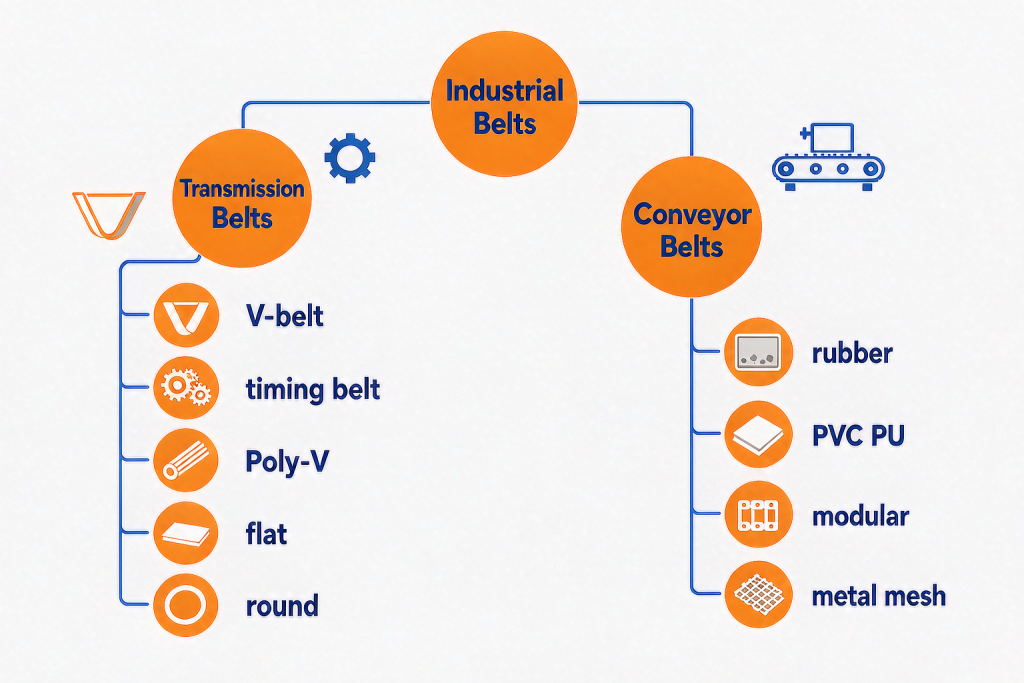
Most confusion starts here. A transmission belt (drive belt) moves power: it takes rotation from a motor or engine and delivers it to a pulley, fan, pump, or cutter. A conveyor belt moves stuff: boxes, coal, cookies, car bodies. Same word, completely different jobs, and the "right" choice for one tells you nothing about the other. We'll take them separately.
Transmission belts — the power movers
V-belts
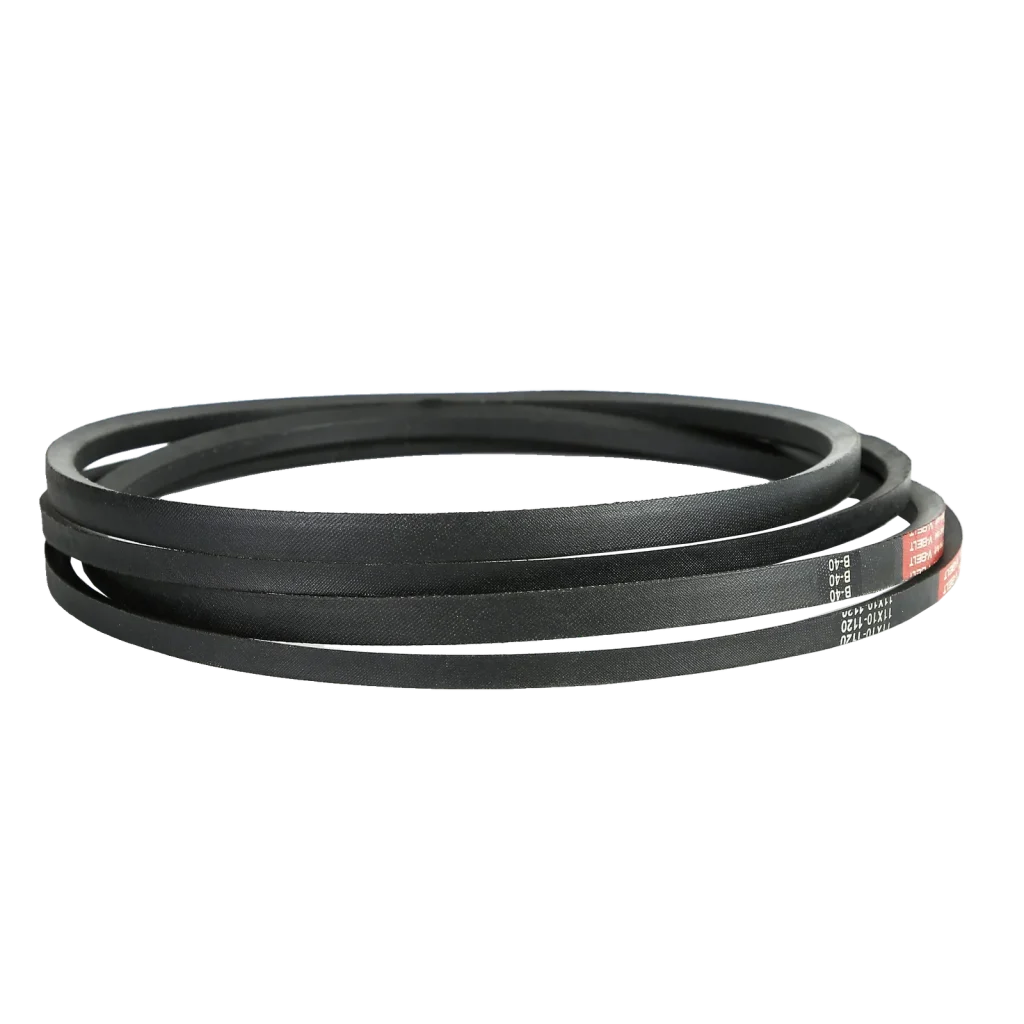
The V-belt (sometimes called a wedge or triangle belt) is the workhorse. Its trapezoidal cross-section seats into a matching sheave groove, and the wedge action is what lets a single small belt hold surprising tension without slipping. You'll see them on pumps, compressors, HVAC blowers, and agricultural equipment. A few variations matter:
- Wrapped (covered) V-belts — the standard, with a protective jacket. Quiet, fine for most jobs.
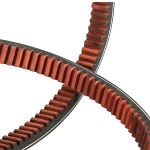
- Raw-edge cogged V-belts — no outer cover and with notches on the underside, so they bend easier around small pulleys and run cooler. Better efficiency, better on short-center drives. See our cogged V-belts.
- Banded V-belts — two or more V-belts joined by a top band, so they can't flip or twist under shock loads. Used where pulsation is brutal: rock crushers, presses. See banded belts.
The plain wrapped version is still the default for general duty; the cogged and banded types are fixes for specific problems (small pulleys, shock loads).
Timing belts (synchronous)
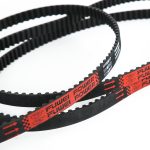
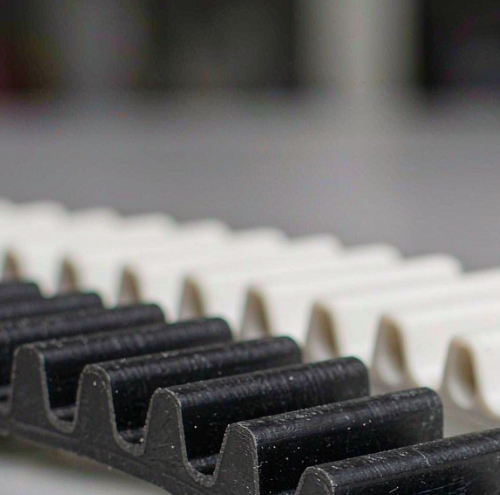
A timing belt has teeth that mesh with matching teeth on a sprocket. No slip, exact ratio — and that's why it times a camshaft to a crankshaft and positions a robot arm to a tenth of a millimeter. Bodies are rubber (neoprene or HNBR) or polyurethane; cords are fiberglass as standard, aramid when you need the belt not to stretch. Two tooth shapes dominate: trapezoidal (the older L/H profiles) and curvilinear (HTD, STD, and the GT series used in 3D printers). Best where synchronization matters and you can't tolerate drift. Browse our timing belts.
Poly-V / ribbed / serpentine belts
One flat belt with several longitudinal V-ribs. It carries multiple accessories off a single shaft — that's the serpentine belt on a car engine — and it's also common in appliances and machine tools. Compact, runs fast and quiet, and handles misalignment better than a stack of separate V-belts. See Poly-V ribbed belts.
Flat belts
The old-timer. A wide, thin belt on large pulleys, historically leather, now usually polyurethane or rubber with a fabric face. Extremely efficient at high speed and light load — think textile spindles, woodworking, some packaging. Not for high torque.
Round belts
Exactly what they sound like: a round cross-section, often polyurethane, used for light duty and for paths that turn corners (ceramics kilns, small conveyors, light assembly). Easy to join, cheap to replace.
Conveyor belts — the product movers
Rubber conveyor belts
The heavy lifters of mining, quarrying, steel, and bulk handling. A fabric carcass (polyester-nylon "EP" plies, or all-nylon) or steel cord carries the load; a rubber cover protects it. Cover compounds are picked for the abuse: abrasion-resistant for rock, heat-resistant for sinter, oil-resistant for oily material. Steel-cord versions move enormous tonnages over long distances.
PVC and PU conveyor belts
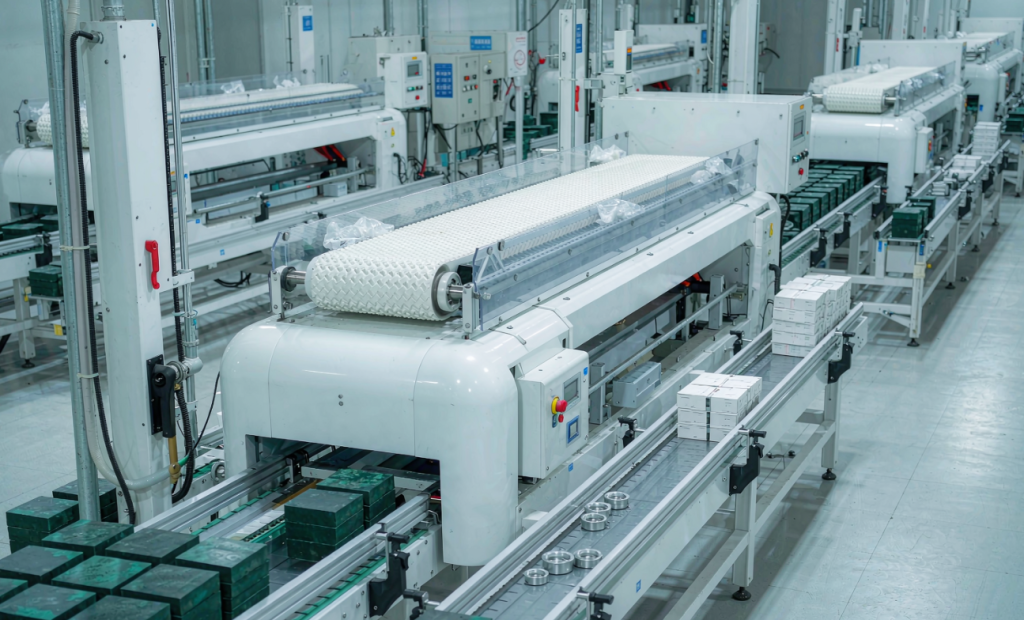
Lightweight belts for factories, airports, food, and packaging. PVC is the cheap generalist; PU is food-grade, cut-resistant, and washdown-friendly. You'll find these in bakeries, bottling lines, and parcel sortation.
Modular plastic belts
Interlocking plastic segments on a chain, built to be taken apart and washed. Perfect for food and pharma where hygiene rules and a smooth belt can't be cleaned deeply enough.
Metal mesh belts
Woven wire, built for heat. They carry parts through ovens, fryers, and sintering furnaces where rubber would melt and plastic would sag. Also used in cooling and washing tunnels.
What the materials actually do
This is where calling something a "polyester belt" or "nylon belt" as a standalone product gets misleading. Polyester and nylon are usually the fabric inside a rubber conveyor belt, not the whole belt. The real material decision is three layers:
- Cover / body: rubber compound (neoprene for oil/weather, HNBR for engine heat, EPDM for weathering), or polyurethane (abrasion, oil, no dust), or PVC (cheap, light).
- Carcass / reinforcement: polyester (low stretch, good troughing), nylon (impact resistance), cotton (legacy), or steel cord (heavy load, long span).
- Tension member in drive belts: fiberglass (standard), aramid/Kevlar (high strength, near-zero stretch), steel (in PU belts, high load).
So when someone says "nylon belt," they usually mean a rubber conveyor belt with a nylon carcass. The belt isn't nylon; the inside is. Getting that straight saves a lot of misorders.
How to pick the right one — a few honest questions
- Moving power or moving product? Transmission vs conveyor. Don't cross the two.
- Need exact speed/position, or just torque? Exact → timing belt. Torque and slip-tolerant → V-belt.
- What's the environment? Heat, oil, cold, washdown, dust-free? That picks the compound.
- How brutal is the load? Shock and pulsation → banded V or aramid; steady light → flat or round.
- Food or pharma? PU or modular plastic, full stop.
Where they actually show up
| Industry | Belts you'll find |
| Automotive | Timing belt (engine), serpentine Poly-V (accessories) |
| Agriculture | Wrapped and banded V-belts on harvesters, tractors, irrigation |
| Mining & bulk | Steel-cord rubber conveyors, V-belts on plant equipment |
| Food & beverage | PU/PVC conveyors, PU timing in clean zones |
| Factory automation & robotics | Timing belts for linear motion, Poly-V on machines |
| HVAC & appliances | V-belts on blowers, Poly-V in washers and dryers |
Questions buyers actually ask
Can one belt do both jobs? No. A transmission belt and a conveyor belt are sized and built for opposite purposes. Don't substitute one for the other.
Rubber or polyurethane for a drive belt? Rubber (neoprene/HNBR) for shock, heat, and forgiveness; PU for precision, clean rooms, and oil. Our rubber vs PU timing belts piece breaks it down fully.
Why does my V-belt keep slipping? Usually wrong tension, worn sheave grooves, or oil on the belt. Tension it properly and check the sheaves before blaming the belt.
Are timing belts really zero-maintenance? No belt is. They don't need lubrication, but they do need correct tension, alignment, and a guard against debris. A skipped tooth means a mistimed machine.
How long should an industrial belt last? Anywhere from months to several years. It depends entirely on load, speed, alignment, environment, and whether anyone maintains it — not on the brand alone.
Need help specifying a belt for your machine? Talk to our engineers at Contact Us, or browse Timing Belts, V-Belts, and Poly-V Belts. Also read our 2026 transmission belt trends.